How does TokenBank work?
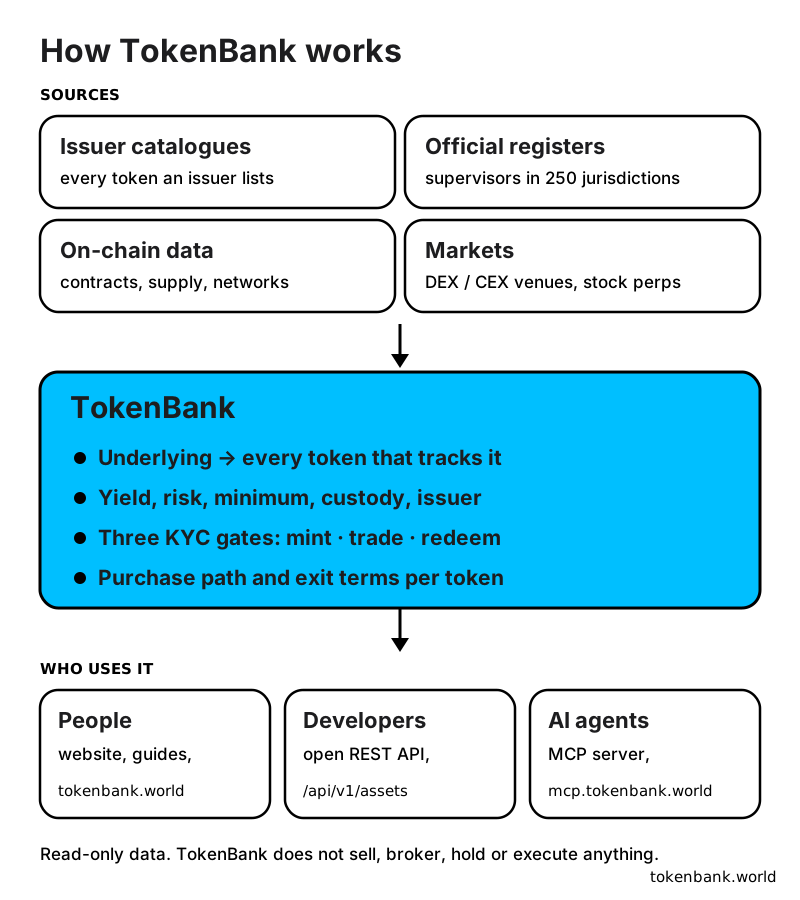
TokenBank collects every tokenized asset it can source — 8,776 live instruments today — links each token to the stock, bond, fund or currency it tracks, and records how it can be bought. 76 of them state a yield, a minimum and a risk, so they can be compared on those figures. The same data serves people, developers and AI agents.
Where the data comes from
- Issuer catalogues — the token lists that issuers such as xStocks, Ondo, Dinari, Securitize or Coinbase publish themselves.
- Official registers — the public registers of supervisors in 250 jurisdictions — who is licensed, which offerings are registered.
- On-chain data — contract addresses per network, supply, and the tokens’ own descriptions, checked against the issuer.
- Markets — where a token trades (DEX and centralised exchanges) and the stock perpetuals on Hyperliquid.
Every row links to its source. A figure without a source is not shown.
One underlying, many tokens
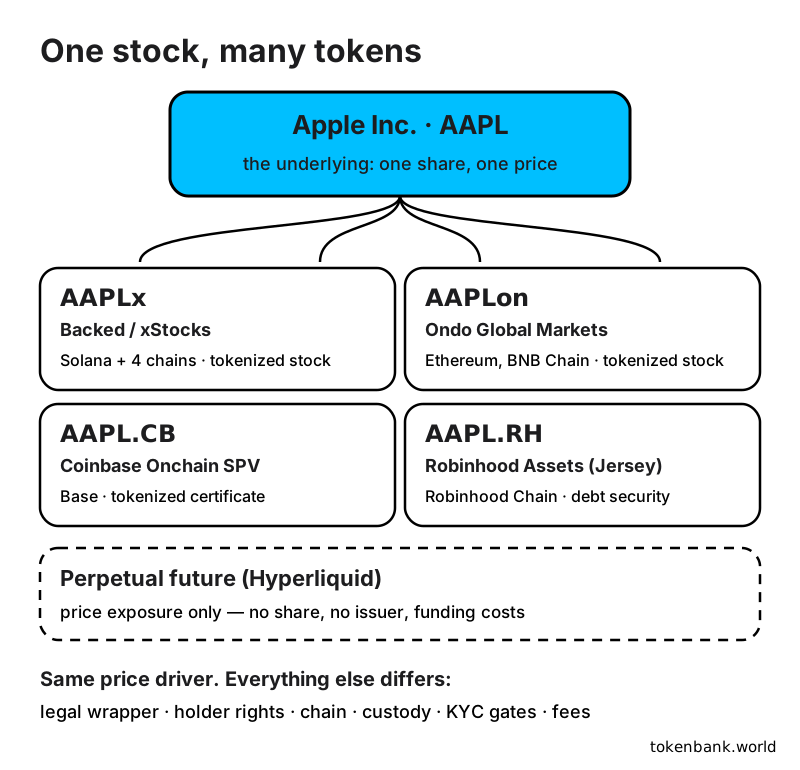
Apple exists on-chain as many separate tokens from different issuers. They follow the same share price but are different products: one is a tokenized share, another a certificate, another a debt security; they live on different chains, with different custody, holder rights and identity checks. TokenBank keeps the underlying apart from each token on it, so they can be compared side by side instead of appearing as unrelated rows.
Two kinds of rows
Three KYC gates and a purchase path
Each token has three points where an identity check can stop a buyer: when it is minted by the issuer, when it is traded on a secondary market, and when it is redeemed. From these gates and the custody TokenBank derives the purchase path — whether a plain wallet can buy it, whether an owner has to be onboarded once, or whether it is bought inside a platform. Today 27 instruments can be bought from a self-custody wallet with no identity check.
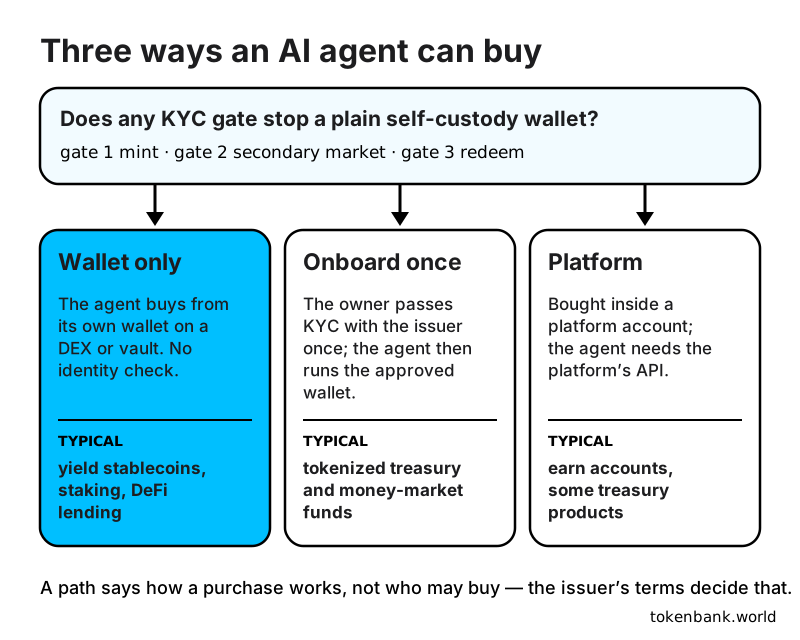
A path describes how a purchase works, not who may buy. The issuer’s terms and the buyer’s own law decide that.
Three ways to read it
What TokenBank does not do
- It does not sell, broker, hold or execute anything, and takes no fee or referral.
- It does not decide who may buy a product — it describes target market and area as the issuer states them.
- It does not give investment advice. Yields are variable and come from the issuers.
Where does TokenBank get its data?
From issuers’ own token catalogues, the public registers of supervisors in 250 jurisdictions, on-chain contract data and the markets where tokens trade. Every row links to its source.
How many tokenized assets does TokenBank cover?
8,776 live instruments, of which 76 state a yield, a minimum and a risk and can be compared on those figures.
Can an AI agent use TokenBank?
Yes. The MCP server at https://mcp.tokenbank.world and the REST API are free and need no key. The tool get_purchase_steps returns how a token is bought; 27 instruments can be bought from a wallet with no identity check.
Does TokenBank sell tokens?
No. TokenBank publishes data only. It does not sell, broker, hold or execute anything and takes no fee or referral.
TokenBank publishes data and does not sell, broker or execute anything. Yields are variable. Not investment advice.